

Child Therapy Littleton, CO
Child Centered, Family Focused, Integrated Support, Lasting Results
When Behavior Is Louder Than Words
If your child could just tell you what was wrong, you would fix it. You would listen, you would help, you would figure it out together. But they do not tell you. They show you, in the only language they have fully available to them right now. The meltdown. The shutdown. The refusal. The explosion that comes out of nowhere over something that seems impossibly small. You are not missing what they are saying because you are not paying attention. You are missing it because nobody taught you to listen for it in this particular way. That is not a parenting failure. That is a language barrier. And language barriers have solutions.
Your Child Has Been Talking All Along.
Day in and day out you brace for what comes next. The meltdown before breakfast. The slow-motion morning that ends with you arriving late to work again. The refusal that locks everything down in the afternoon. The non-stop demands, interruptions, noise, and energy that you can feel vibrating through your body. You fantasize about having some time to wind down at the end of the day, but dread bedtime. Just as confusing and heavy are the moments your child shuts down, pulls away, isolates, disappears into a world of their own creation, or stops trying.

When you have tried talking, seeking to understand and do not know what else to try. Seeking the support of a child therapist is a brave step for you to take.
You have tried everything you could think of. Everything you read about. Everything that seems to work for other parents. You have watched your child struggle and trusted your gut that something more is going on, and then you have sat across from pediatricians, teachers, caregivers, and specialists and tried to find the words for something that defies easy description. They listened. They gave you something. A diagnosis, a strategy, a referral, a reassurance that was meant to help but landed a little hollow. And you walked out still carrying the same weight you walked in with, plus the quiet suspicion that nobody has actually seen the whole picture yet. Not really. Your child has been communicating the whole time. The behavior isn’t a problem to be fixed, it is a message. It has always been the message. When we understand the message, the communication (behavior) can change.
Child Therapists Know How to Listen.
That takes courage to admit, and it is worth saying clearly: not being able to hear it is not a failure. You are too close to it. You are in every hard moment with your child, which means stepping back and hearing what the behavior is actually saying is nearly impossible from where you are standing. You are speaking the same language, living the same moments, and that closeness, as much as it is your greatest strength as a parent, is also what makes the translation so hard.
Listening to behavior, staying curious enough to hear underneath the noise and the chaos and the shutdown, is something I have spent years practicing. Not just to understand it myself, but to share that understanding with the children and families I work with. A child therapist is trained to hear what the behavior is saying, to hold the whole picture as it comes into focus, and to bring you into that understanding so you can hear it too. That is the heart of this work. It is what gets me to the office every day.
When You Learn to Hear What They Are Saying, Everything Changes.
When the language finally starts to make sense, you will begin to see your child differently. Not as a child with a behavior problem to be fixed, but as a child with something important to say who has not yet found a way to say it that the adults around them can hear. And when that shift happens, something opens up. The meltdown that used to send you into crisis mode starts to tell you something instead. The shutdown that felt like rejection starts to feel like a signal you know how to read. The morning that used to be a battlefield starts to give you information. You stop bracing for the next hard moment and start getting curious about what it is trying to tell you. That shift, from managing to understanding, changes the entire texture of your relationship.
That is when your child starts to shine. Not because the hard moments disappear overnight, but because you can finally see past them to what is actually there. The sensitivity that makes everything harder is the same thing that makes them more perceptive, more creative, more deeply connected than most people around them realize. The intensity that exhausts you is the same energy that builds entire worlds when it has somewhere to go. The child who seemed unreachable was never unreachable. They were waiting for someone who spoke their language, and when you learn to speak it too, they feel that. They know. And that knowing changes everything between you.
Understanding what your child's behavior is communicating changes everything. That understanding starts with a single conversation. Book a free consultation at the link below, and let's figure out what your child needs together.

All Emotions are welcome in the therapy space! Silly, Excited, Angry, Frustrated, Worried. Your child gets to bring all of that into their interactions with their therapist.
Child Therapy: The Work from 3 Essential Viewpoints
Most families arrive at that first appointment carrying a mix of hope and uncertainty. You have navigated the logistics, the scheduling, the explaining it to a child who may or may not have wanted to come. And now you are here, in the parking lot, taking a breath before you walk through the door. That moment, the one right before everything starts, is worth naming. Because what comes next is not what most people expect.
What your Child Would Tell you About Therapy
I know you wonder sometimes. You sit out there, and you hear me laughing or playing or just being loud, and you think, is this actually doing anything? And then there are the sessions where it goes quiet in there, really quiet, and that probably feels harder to make sense of from where you are sitting. I need you to trust me on this one. Both of those things, the noise and the silence, are the work.
I know I do not always have the words for what is hard. I might not even have the experiences yet to know why something feels the way it feels. But I know something is heavy. I know something is off. I know what I need to work on even if I could not sit across from you at the kitchen table and explain it. I carry it with me everywhere. In here, I finally have somewhere to put it down for a little while and look at it, in my own way, at my own pace.
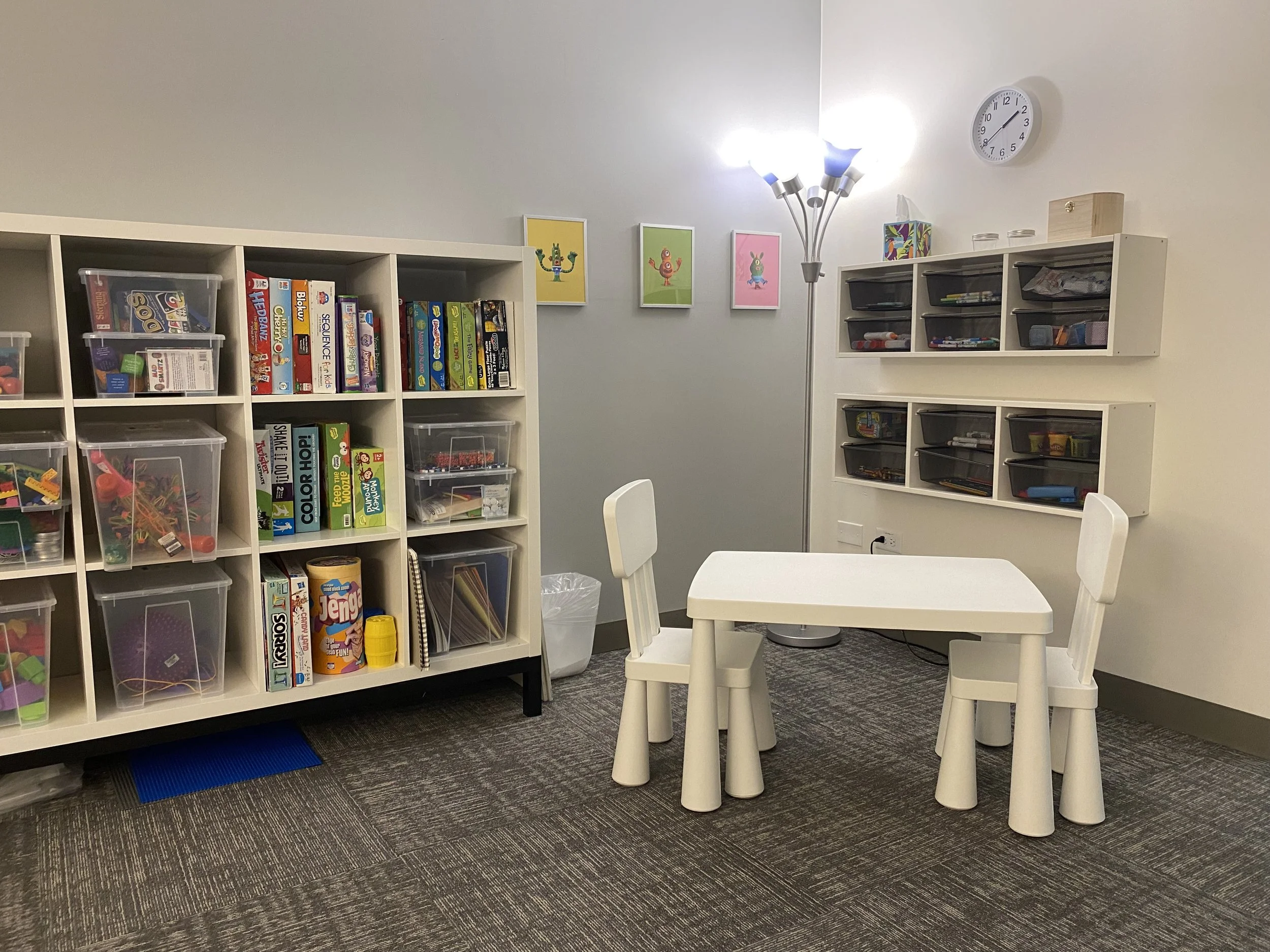
A welcoming space where kids set the pace and make choices on their pathway to healing, connection, and regulation.
This might be one of the only places in my life where I actually get to choose. What I do and how. Where I start. What I bring in today and what I leave for later. I do not get a lot of choices. Most of my day is decided for me: where I go, what I do, when I eat, when I stop. In here, I lead. That matters more than it might seem from the outside.
I am also figuring out if this place is safe. I do it the same way I figure out everything, by testing it a little. By seeing what happens when I make a choice that is mine. By noticing whether the adult in the room follows my lead or tries to move me somewhere else. By feeling, slowly and without being able to name it, whether this is a place where I can actually exhale. That takes time. Please give me that time.
And then on the way home, I know you are going to ask me questions about what I did, what I talked about, what I am working on. I am going to say I don't know. I need you to hear that as something other than nothing. Think about it this way: if you were in therapy, and someone you loved asked you what you talked about the moment you walked out the door, you would probably share what you wanted to share and leave the rest alone. You wouldn’t do that because nothing happened, but because some of it is still being processed and sharing it before you are ready would change something about it. I am the same way. I will share what I want to share, when I am ready to share it, and not before. That is not me shutting you out. That is me asking for the same respect you would want for yourself.
What I bring in here stays here. I am going to figure that out through experience, not because anyone told me so. And when I feel it in my bones that nothing I say or do or play in this room travels back through that waiting room door, that is when I can start bringing the real stuff. Not before. You cannot rush that part, and honestly, you would not want to. The more you trust the process, the faster it actually moves. That is not a paradox. That is just how trust works.
It might take me a few sessions to settle in. Maybe longer. I am not stalling. I am building something. The foundation I need to do the work you brought me here to do is being laid right now, even when it sounds like I am just playing. Especially when it sounds like I am just playing.
I look forward to coming here. I really do. But I need you to know it is not just fun. It is the most important kind of work I know how to do right now, and I am doing it every single time I walk through that door. Even when it doesn’t look, sound, or feel like anything is happening (or changing).
The Therapist's View: Doing What I Do With Presence, Intention and Purpose
From the moment I meet you and your child in the waiting room, my attention is on them. I get down to their level. I let them set the pace for how much interaction they want before we head back. I am not rushing toward the playroom or the work or the agenda. I am following their lead, and that starts before we even close the door.

Big play and hard work in therapy require a lot of regulation and rest. Snacks, quiet/cozy spaces and proximity to adults while we check help support the work in session.
I have designed my playroom and my entire office with your child's nervous system in mind. There is a cozy corner for rest and snacks, open space for big movement and active play, a sand tray, art materials, puppets, figures, sensory tools, and plenty of room for your child to express whatever is showing up that day in whatever form it takes. The space itself sends a message before I say a single word: you are safe here, you can move, you can be loud, you can be quiet, you can be exactly who you are today.
I genuinely love working with children. Not because they are easier than adults; they are not, but because they are so extraordinarily authentic, honest, and vulnerable when they feel safe, seen, and heard. They do not perform progress. They do not tell you what they think you want to hear. When a child trusts the space, what shows up is real, and that realness is where the work actually lives. I trust children to know what they need. I trust them to find their way to it. My job is to create the conditions where that can happen, follow their lead once it does, observe/witness/reflect back to them what is being explored and support reflective self-awareness (yep, even my youngest clients can do all of that!).
This is not about teaching your child how to behave. It is about helping them feel safe enough to eventually choose new ways of being. We begin with the why underneath the behavior, not the behavior itself. Once connection, regulation, and felt safety are in place, skills stop being things we try to teach in hard moments and start becoming things your child reaches for on their own, across settings, at home, at school, in the community, and with friends. That shift does not happen because I pushed for it. It happens because your child was finally given enough space and safety to find it themselves.
From One Parent to Another
I remember sitting where you are sitting right now. Tired. A little desperate, if I am being honest. I had tried the strategies. I had read the books. I had sat in enough school meetings, evaluations, and doctor’s appointments to last a lifetime. Trying to figure out how to add one more thing to our all ready overscheudled, overbooked, and overextended week. I was not sure therapy was going to be different, and I want to be straight with you: it is different, but not always in the ways you expect.
The waiting room is harder than you think it will be. You will sit there and listen through the wall and wonder what on earth is happening in there and whether the laughing you hear means your child is not taking it seriously. They are. I know it can feel hopeless when you can do sit there session after session not knowing exactly what is happening on the other side of that door, and you have to keep choosing to trust something you cannot see. That choosing is part of your work in this process. It counts even when it does not feel like anything is changing.
The check-in at the end of each session is brief, just enough to confirm you are on track, and the first few times you will want more from it than it gives. Give it time. The real conversations happen in the parent consultation sessions, and those are where things started to shift for me in ways I did not expect.

Parent Consultation sessions are a time to explore more deeply your child’s progress as well as how to support and sustain the changes you are hopeful that child therapy will produce
The parent consultation sessions are where I stopped feeling like I was watching from a distance and started feeling like I was actually part of what was moving things forward. I came in thinking they would be about my child. They were, but they were also about me, about my patterns in the hard moments, about the map I did not know existed, about what was actually happening underneath the behavior that had been driving me to the edge. That map changed how I moved through the ordinary moments at home. Morning/Evening Routines, Meal Time, Daily Chores, Errands, you know, all the everyday things that you have been holding your breath and white-knuckling your way through for as long as you can remember. Not perfectly and not all at once, but more than before, and that more added up.
I am not going to tell you it is easy or fast. I am going to tell you it was worth it, for my child and for me, and that the first step is just making the call. Book the free consultation. See how it feels. That conversation costs you nothing, and it might be the one that finally provides some relief.
FAQs About Integrated Child Therapy Services in Denver CO
-
Every client receives both, because meaningful, lasting change happens when children feel safe and caregivers feel supported. Our integrated model includes individual therapy sessions for your child, family therapy sessions as needed, and regular parent consultation. These sessions follow a predictable format and are tailored to your family’s needs. The frequency and focus may vary depending on your goals, but this combination is at the heart of how we support growth for the whole family.
-
Parent consultations are essential and thoughtfully paced. In the early stages, we may front-load a few foundational sessions to build understanding and equip you with tools. After that, we schedule at a rhythm that supports your child’s therapy process and offers space for ongoing reflection, learning, and support. The goal is to create a strong, steady container around your child’s growth, one where you're not only included, but empowered.
-
You don’t need to have it all figured out. Sharing your observations and experiences: big emotions, school struggles, behavior changes, or family stress gives us a helpful starting point. Anything that helps me understand your child and your hopes for therapy is welcome. The focus early on is on building relationship, rapport, and trust.
-
Therapy sessions are child-led and play-based. Whether your child is building with blocks, painting, storytelling, or engaging in pretend play, I’m using that creativity to help them express feelings, explore challenges, and build emotional resilience. It’s playful on the outside, with purposeful therapeutic work underneath.
-
Progress may show up in subtle but powerful ways — fewer meltdowns, easier transitions, stronger communication, or more peace at home. We regularly review goals in parent sessions, and I’ll share what I observe in the playroom. Together, we reflect, adjust, and celebrate the growth.
-
That’s totally okay. Many kids feel unsure in the beginning. I focus on creating a safe, predictable, and welcoming space. With time and trust, most kids grow curious and engaged. We move at their pace, never rushing the relationship.
-
At the start or end of each therapy session, we’ll do a brief check-in to stay connected. This is your space to share updates, ask questions, or flag anything that came up during the week. These touchpoints help us stay aligned and make sure you feel supported in real time.
-
Yes. With your permission, I’m happy to connect with your child’s teachers, pediatrician, psychiatrist, or other therapists. Collaboration helps ensure that everyone is aligned and working toward the same goals.
-
While I don’t offer formal diagnostic evaluations, I can help identify when an assessment might be beneficial and refer you to trusted professionals. I’ll also support you in preparing for and making sense of the process.
-
You’ll receive curated resources including book recommendations, podcasts, regulation tools, and handouts to take with you and use as needed. These materials are chosen to match your goals and help you feel more equipped day to day.