

Play Therapy, Denver CO
Synergetic Play Therapy for Healing, and Emotional Growth

When Your Child Is Struggling, Play Therapy Can Help
You didn’t picture therapy being part of your parenting journey, but lately, things have felt harder than they should. Your child is struggling: maybe it’s explosive outbursts, total shutdowns, constant defiance, or simply not being able to participate in everyday routines. You've worked so hard to create consistency, set expectations, and give your child the tools to succeed, but nothing seems to be working the way it should.
Some days, you lose count of how many meltdowns or moments of defiance happened before noon. Other days, you find yourself wondering where your joyful, playful child went, the one now hiding behind withdrawal, zoning out, or shutting down. You get frustrated when you ask what is going on and get no response. Maybe they’re too young to put their feelings into words, or maybe they just won’t open up right now. Either way, you’re here because you care deeply, and you know something needs to change. The good news? You don’t have to figure it out alone.
And as if that weren’t enough, the challenges follow your kid everywhere: school, activities, friendships.

For a while, you told yourself it was just a phase, that with time and patience, things would get better. But now your child is going to childcare/or school, navigating playdates, and trying to find their place in a world that doesn’t always feel made for them. You’re watching them struggle in ways other kids don’t seem to and it’s breaking your heart.
You’ve heard the sideways comments from family. You’ve sat through daycare or school meetings that left you feeling ashamed, helpless, or even judged. Maybe you’ve argued with your partner about how to handle it, or started dreading drop-off and pick-up because you’re bracing for another report of “what went wrong today”. Every time your phone rings and you see the caller ID indicating childcare or school, a cold chill runs down your spine. “Here we go again”! You’ve even brought it up with your child’s pediatrician. And while their advice may have been well-meaning, deep down, you know...
Your child needs more. Your family needs more. And that’s where play therapy comes in.
Your Child’s Behavior Is Communication, and I’m A Play Therapist Here to Listen
Can play therapy help if my child won’t talk about their feelings?
The truth is: they don’t need to talk — they need to play.

At my Littleton-based practice, I specialize in Synergeticplay therapy — a research-backed approach that helps children process emotions, increase self-awareness, build emotional regulation, and resolve inner conflict, all through developmentally appropriate methods.
My approach to therapy is deeply rooted in these beliefs and values:
Children behave well when they are regulated, connected, and experience felt safety
Behavior is a form of communication
Play is the language of children
That’s why in our therapy sessions, your child leads. In the playroom, they’re free to express themselves, explore emotions, and safely work through challenges at a pace that feels right to them. We approach every session with curiosity, wonder, and playful attunement, allowing your child to feel seen, respected, and empowered. We model regulation, offer co-regulation, and move towards the perceived challenges that arise through play.
What Makes Play Therapy Effective?
Play Therapy harnesses the healing powers of play
When children engage in play therapy, they are rewiring their brains. This isn’t about rewards and consequences or short-term fixes.
It’s about creating lasting internal changes in how your child experiences and interacts with the world.
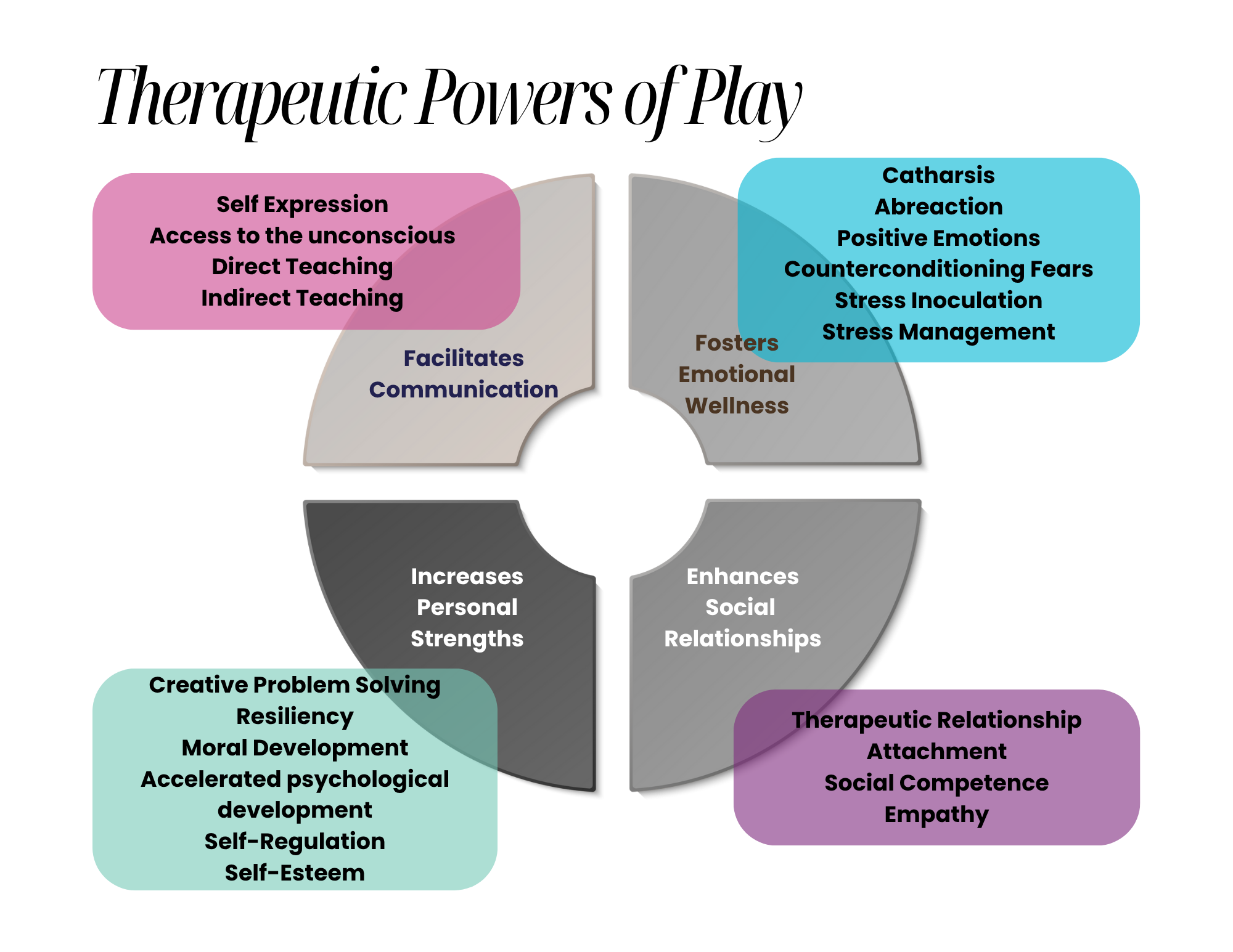
Through play, your child can:
Build emotional regulation and resilience
Reprocess difficult experiences or trauma
Learn new coping skills
Improve self-esteem
Strengthen relationships at home, school, and beyond
Much of your child’s therapeutic process will be non-directive, meaning it’s led by your child’s own interests, pace, and imagination. I thoughtfully weave in directive interventions when they can be most helpful. These therapist-guided moments may include bibliotherapy (using books and stories to spark insight and connection), psychoeducation about the brain and emotions, and play-based activities designed to gently introduce, practice, and strengthen new skills. These approaches support your child in navigating both their inner world (thoughts, feelings, self-awareness) and outer world (relationships, school, and daily life challenges). We also recognize the essential role you play in your child’s growth, so we provide you with practical strategies, education, and encouragement to carry these tools into your home life. This way, the growth that happens in the therapy room can continue to deepen and take root in your child’s everyday experiences.
Play therapy that integrates support for parents
Parents are essential to the therapy process and sustainable outcomes
When your child is struggling, it can feel like you’re carrying the weight of the world on your shoulders. You may wonder if you’re doing something wrong or feel frustrated that nothing seems to be helping. We understand how isolating and exhausting this can be, and that’s why we make supporting you a central part of the play therapy process.
Parent consultation is built into our work together from the very beginning. These sessions give us a chance to check in privately, away from your child, so you have space to share what’s been going on at home, ask questions, and gain tools that fit your family’s unique needs. This isn’t about judging your parenting; it’s about joining forces with you to help your child heal.
I believe you were made for more than simply getting your child to their appointment on time! You may not ever step inside the playroom for a full session with your child, but you are going to be involved in your child’s therapy process. Parents can learn the skills needed to build (and be) the scaffolding for change that lasts! That’s why in our parent consultation sessions, we prioritize:

Understanding what’s beneath the behavior – We’ll help you see the patterns, triggers, and emotional needs that drive your child’s actions.
Learning how to respond in connection-based ways – We’ll explore practical strategies that bring more calm, trust, and cooperation into your home.
Strengthening your parent–child relationship – Together, we’ll focus on building moments of safety, joy, and emotional closeness.
Increasing your own capacity for self-regulation – You’ll gain skills for staying grounded, even during meltdowns or conflict, so you can co-regulate effectively.
Restoring your confidence as a parent – You’ll leave feeling more capable, supported, and hopeful.
Parent consultation is not an optional extra; it’s a vital part of the play therapy journey. While your child engages in important healing work in the playroom, our regularly scheduled, structured parent consultations ensure that those gains are supported, strengthened, and carried into everyday life.
You don’t have to figure this out alone. We’re here to walk alongside you, helping you feel more connected to your child and more confident in yourself.
Frequently Asked Questions about Play Therapy in Denver CO
-
Play therapy uses toys, art, movement, and play (in lots of forms) to help children express emotions and work through challenges in a developmentally appropriate way.
-
Play therapy is ideal for children struggling with behavior issues, anxiety, trauma, emotional regulation, social skills, and more.
-
Most children can begin play therapy around age 3 and continue through early adolescence.
-
Each child is different, but most families begin to notice changes within 8–12 sessions. Some children benefit from longer-term support.
-
Yes! Parent collaboration is a key part of our process. We’ll check in regularly and provide strategies for home.
-
Look for consistent aggression, withdrawal, emotional outbursts, difficulty in relationships, trouble at school, or major life changes.
-
While talk therapy is language-based, play therapy speaks the child’s natural language — play — allowing them to process in a way that feels safe and intuitive.
-
Yes, we offer regular parent consultations to help you feel supported and equipped to meet your child’s needs.
-
Yes, play therapy is supported by decades of research and shown to be effective for a wide range of child mental health concerns.
-
The Metro Denver area is large and includes multiple cities and counties. Our office is located in Littleton CO (Broadway/Dry Creek), making it easy to access from Englewood, Littleton, Centennial, Lone Tree, Highlands Ranch and Ken Caryl.